
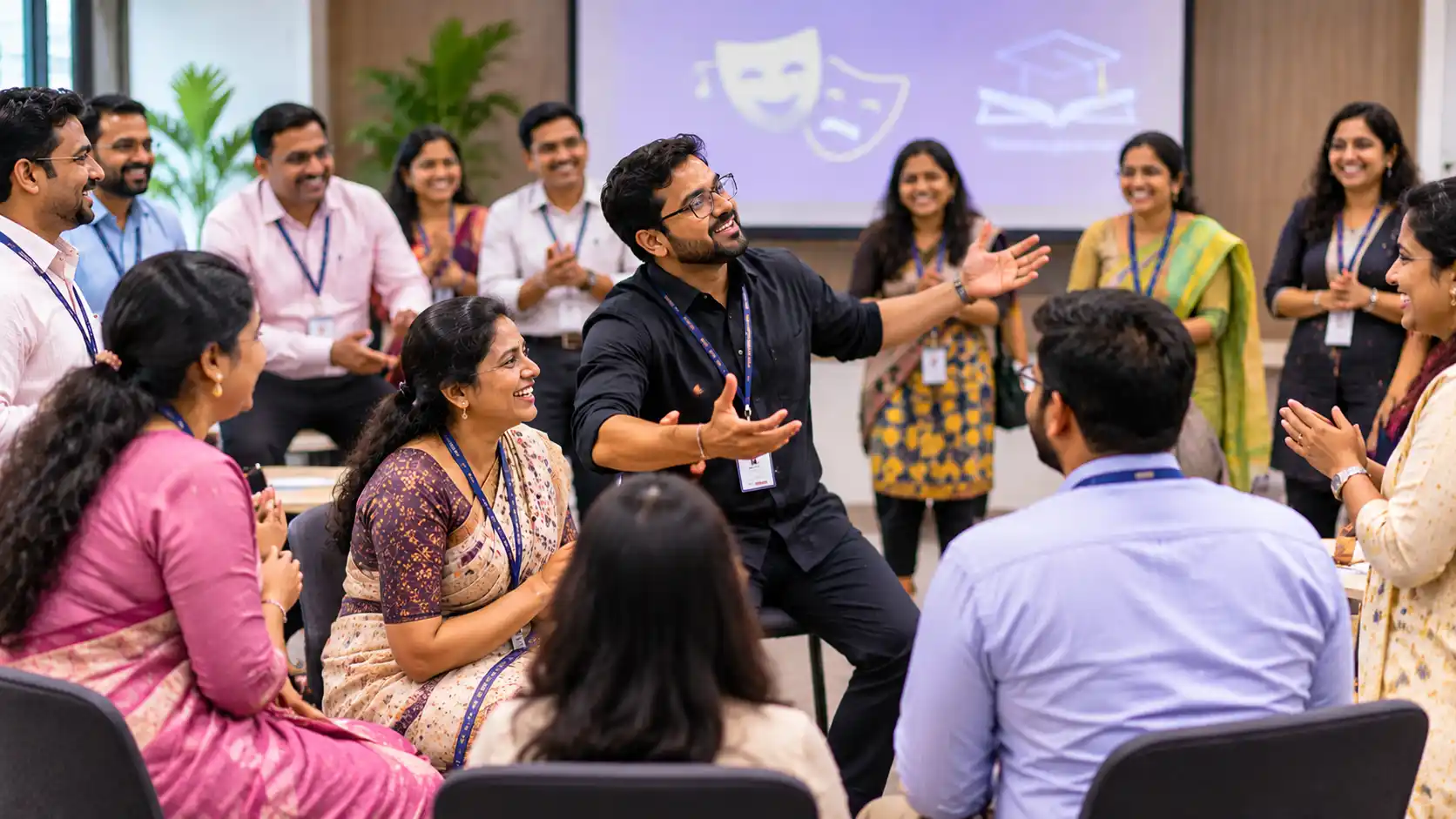
How drama-based experiences helped staff explore teamwork, leadership and personal effectiveness across a large educational group
The people behind an institution’s everyday success
An educational institution is known for the quality of its teaching and the success of its students. But its everyday experience is also shaped by many people who work behind the scenes: administration teams, campus support staff, coordinators, operations teams and faculty members. Their communication, cooperation and sense of responsibility influence how smoothly the institution functions.
In a large educational group with multiple institutes and departments, employees may work in different roles and locations. They may not always have the opportunity to interact beyond their immediate teams. Creating a shared understanding of teamwork, leadership and personal development can help people work together more effectively.
Nalanda Business Associates conducted a series of workshops for non-teaching staff and selected teaching staff across different institutes within a large educational group. The documented institutional testimonial refers to sessions for Grade II and Grade III non-teaching staff across campuses
Introducing ACTION: learning through drama and participation
ACTION is Nalanda’s drama-based experiential learning workshop. It uses theatre techniques, team activities, improvisation and reflection to make learning active and memorable. It is built on a simple idea: people often understand a behaviour more deeply when they experience it rather than only hear someone explain it.
Participants are invited to take part in activities, respond to situations, work with others and reflect on what happened. The learning can then be connected to workplace themes such as communication, collaboration, leadership, trust, confidence and personal effectiveness.
ACTION is sometimes described as ‘Entratainment’—a blend of entertainment and training. The energy and enjoyment are important, but they serve a learning purpose. The objective is not to put people on a stage or turn them into actors. It is to create an environment where they can observe themselves and others, try different responses and discover useful lessons.
A series of interventions, not just one event
The institutional testimonial records different interventions delivered over time. These included a programme titled ‘Whale Done’ for Grade II non-teaching staff, a book review session based on ‘One Minute Manager’ for Grade II and Grade III staff, and a team-play intervention. The sessions addressed leadership, team building and personal development competencies.
The testimonial specifically notes that the team-play programme was highly appreciated and recommended for all levels. It also acknowledges the facilitator’s dedication, commitment and timely completion of the proposed workshops. Staff feedback was described as very positive, with the training programmes considered effective.
This feedback matters because it points to more than the enjoyment of an activity. It suggests that participants and the institution valued the relevance of the experience and the way it was delivered.
The facilitator’s role: create the experience, connect it to work
Girish Dharap facilitated the workshops with a focus on participation, energy and reflection. His experience in corporate training and theatre-based facilitation helped create an environment in which participants could engage with activities and learn from one another.
A drama-based workshop needs more than a set of games. The facilitator must help participants understand why an activity matters. After an exercise, the group can explore what helped or hindered teamwork, how communication took place, who took initiative and what happened when plans changed. The facilitator then connects these observations to the participants’ actual work environment.
This is where ACTION moves beyond entertainment. The activity creates a shared experience; reflection turns it into insight; and the discussion helps participants consider what they might do differently at work.
Why experiential learning can be powerful in institutions
People working in different roles may have different ways of communicating and solving problems. A shared experiential activity can create a common point of reference. Instead of discussing teamwork only in abstract terms, participants can remember a moment when cooperation made a difference—or when a lack of coordination made an activity difficult.
For non-teaching teams, this can support stronger coordination and service orientation. For faculty and academic teams, it can create space to reflect on communication, collaboration and leadership. For mixed groups, it can help people see colleagues beyond job titles and departments.
The format is also adaptable. The design, activities and reflection can be shaped around the audience, the institution’s priorities and the time available. The core remains the same: active participation, observation and practical learning.
The Nalanda perspective
The written testimonial from the institution’s Head of Training & Development acknowledges the effectiveness of the workshops, the facilitator’s professionalism and the positive response from staff. It also recommends the team-play experience for all levels. This provides a useful example of how experiential learning can be applied in a large, multi-institute environment.
When learning steps off the stage and into the workplace, people have an opportunity to turn a memorable experience into a more thoughtful way of working together.
| THE NALANDA TAKEAWAY ACTION is not drama for drama’s sake. It is a purposeful learning experience where participation creates insight, reflection builds awareness and workplace connection gives the learning meaning. |